A Look at the Effects of Urban Heat Islands During Cold Weather
Special Stories
26 Jul 2018 9:47 AM
From Princeton University
Researchers have found that the urban heat island effect — cities are hotter in the summer than their surrounding areas — also helps keep cities warmer during extreme cold. The findings have implications for urban planners in areas such as New York City or Chicago, which experience marked seasonal temperature swings.
Jiachuan Yang, a post-doctoral researcher, and Elie Bou-Zeid, a professor of civil and environmental engineering at Princeton University, analyzed urban temperatures in 12 U.S. cities in the Northeast and Midwest during a 2014 cold wave. They found that urban areas stayed warmer than the surrounding suburbs and country. The difference in temperature was greatest during the cold wave, which set more than 49 low-temperature records. The temperatures differences were also more pronounced at night than during the day.
The findings, reported in the June issue of the Journal of Applied Meteorology and Climatology, could inform policies for northern cities seeking to mitigate extreme temperatures and curb year-round energy use.
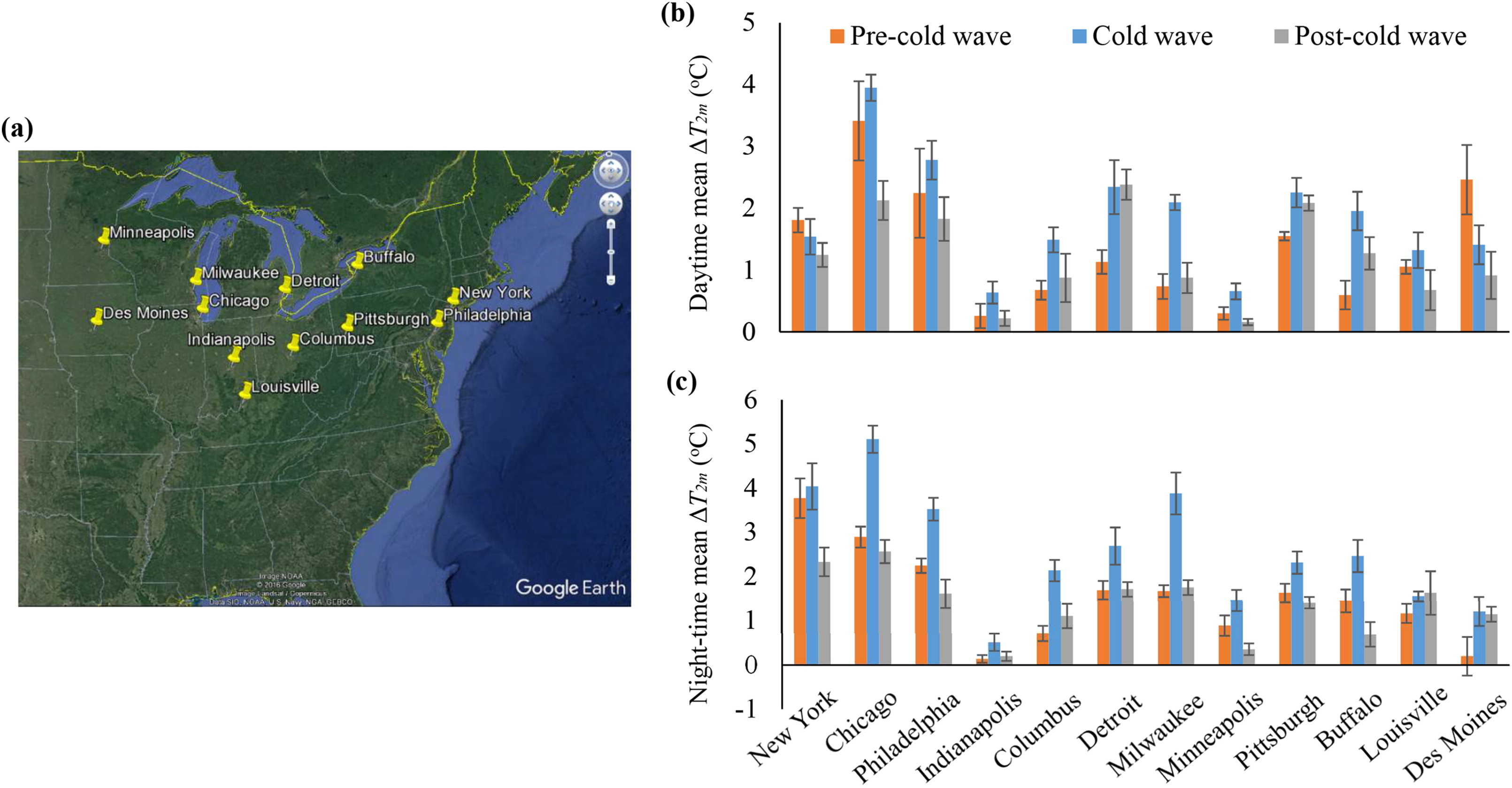 [The locations of the 12 studied U.S. cities (courtesy of Google Earth), and their observed UHIs during the early 2014 North American cold wave: (b) daytime and (c) nighttime. From AMS]
Urban heat islands have been extensively studied during heat waves, with recent analyses showing city temperature boosts can be as high as 8 degrees Fahrenheit for large cities like New York City or Washington. Yang and Bou-Zeid’s study is among the first to examine the phenomenon during cold waves. Yang said that for some areas, cold extremes will continue to pose a challenge even as the climate warms. “More weather-related mortality worldwide is attributed to exposure to excessive cold than to excessive heat, and global warming is unlikely to change this reality,” he said.
The researchers combined temperature and land use data with high-resolution weather simulations to investigate the 2014 cold wave in Chicago. The results suggested that heat released from buildings was a key contributor to the stronger heat island effect observed during the cold wave.
“When you heat buildings, the heat is going to be released from the buildings and go out into the urban environment,” Yang said. In the city, skyscrapers create street canyons that trap heat, while in rural areas heat from buildings dissipates more rapidly into the surroundings. During cold waves, street canyons help cities reduce heating demand and make being outdoors more tolerable, Yang said.
[The locations of the 12 studied U.S. cities (courtesy of Google Earth), and their observed UHIs during the early 2014 North American cold wave: (b) daytime and (c) nighttime. From AMS]
Urban heat islands have been extensively studied during heat waves, with recent analyses showing city temperature boosts can be as high as 8 degrees Fahrenheit for large cities like New York City or Washington. Yang and Bou-Zeid’s study is among the first to examine the phenomenon during cold waves. Yang said that for some areas, cold extremes will continue to pose a challenge even as the climate warms. “More weather-related mortality worldwide is attributed to exposure to excessive cold than to excessive heat, and global warming is unlikely to change this reality,” he said.
The researchers combined temperature and land use data with high-resolution weather simulations to investigate the 2014 cold wave in Chicago. The results suggested that heat released from buildings was a key contributor to the stronger heat island effect observed during the cold wave.
“When you heat buildings, the heat is going to be released from the buildings and go out into the urban environment,” Yang said. In the city, skyscrapers create street canyons that trap heat, while in rural areas heat from buildings dissipates more rapidly into the surroundings. During cold waves, street canyons help cities reduce heating demand and make being outdoors more tolerable, Yang said.
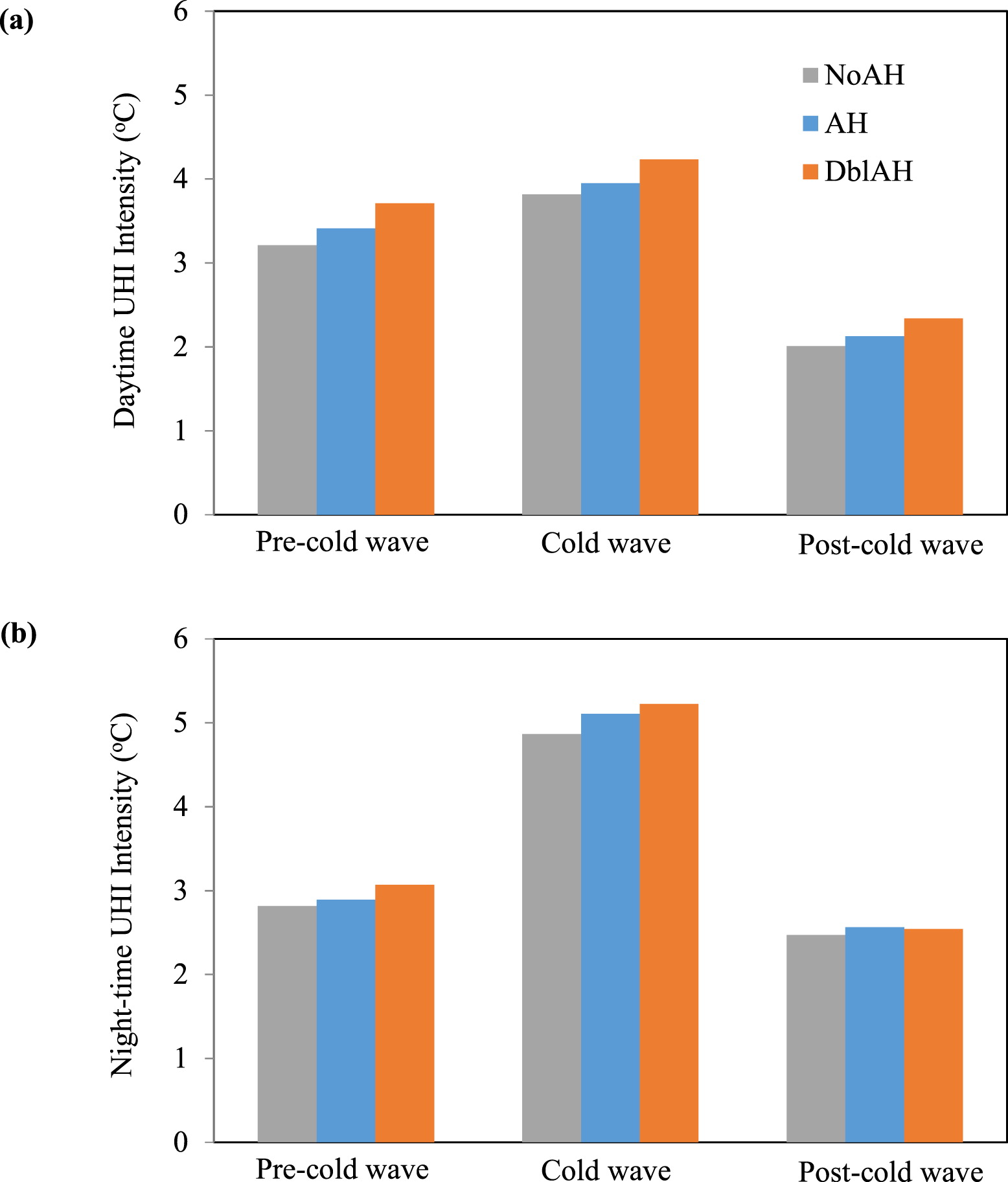 [Model-simulated mean (a) daytime and (b) nighttime urban heat island intensity across the study period with different amounts of heat. From AMS]
During the cold wave, Yang and Bou-Zeid also found an enhanced difference in the amount of heat released at night in the city compared to rural areas. Their simulations showed this was due to the city’s thermal battery function — concrete and other engineered materials’ ability to store more heat than soils, and to discharge this heat when temperatures drop. Colder nighttime temperatures appeared to stimulate heat exchange.
Many cities are working on ways to mitigate summer heat. These include installing cool roofs, which are covered with light-reflecting materials; and green roofs, which are covered with plants that reduce temperatures by evaporative cooling when moisture is released into the air. The researchers modified their simulation to test the effects of cool roofs and green roofs on the urban heat island during a cold wave. They found that cool roofs reduced daytime temperatures, while green roofs led to a small increase in daytime temperatures and a somewhat larger reduction in nighttime temperatures, due to the lower heat storage capacity of soils compared to traditional building materials.
Dan Li, an assistant professor at Boston University, said the work offers lessons for planners. “This work highlights the fact that we need to consider the seasonal variability of urban heat islands and assess the associated hazards and benefits in a comprehensive way,” said Li, who conducted doctoral and post-doctoral research with Bou-Zeid but was not involved in the present study.
[Model-simulated mean (a) daytime and (b) nighttime urban heat island intensity across the study period with different amounts of heat. From AMS]
During the cold wave, Yang and Bou-Zeid also found an enhanced difference in the amount of heat released at night in the city compared to rural areas. Their simulations showed this was due to the city’s thermal battery function — concrete and other engineered materials’ ability to store more heat than soils, and to discharge this heat when temperatures drop. Colder nighttime temperatures appeared to stimulate heat exchange.
Many cities are working on ways to mitigate summer heat. These include installing cool roofs, which are covered with light-reflecting materials; and green roofs, which are covered with plants that reduce temperatures by evaporative cooling when moisture is released into the air. The researchers modified their simulation to test the effects of cool roofs and green roofs on the urban heat island during a cold wave. They found that cool roofs reduced daytime temperatures, while green roofs led to a small increase in daytime temperatures and a somewhat larger reduction in nighttime temperatures, due to the lower heat storage capacity of soils compared to traditional building materials.
Dan Li, an assistant professor at Boston University, said the work offers lessons for planners. “This work highlights the fact that we need to consider the seasonal variability of urban heat islands and assess the associated hazards and benefits in a comprehensive way,” said Li, who conducted doctoral and post-doctoral research with Bou-Zeid but was not involved in the present study.
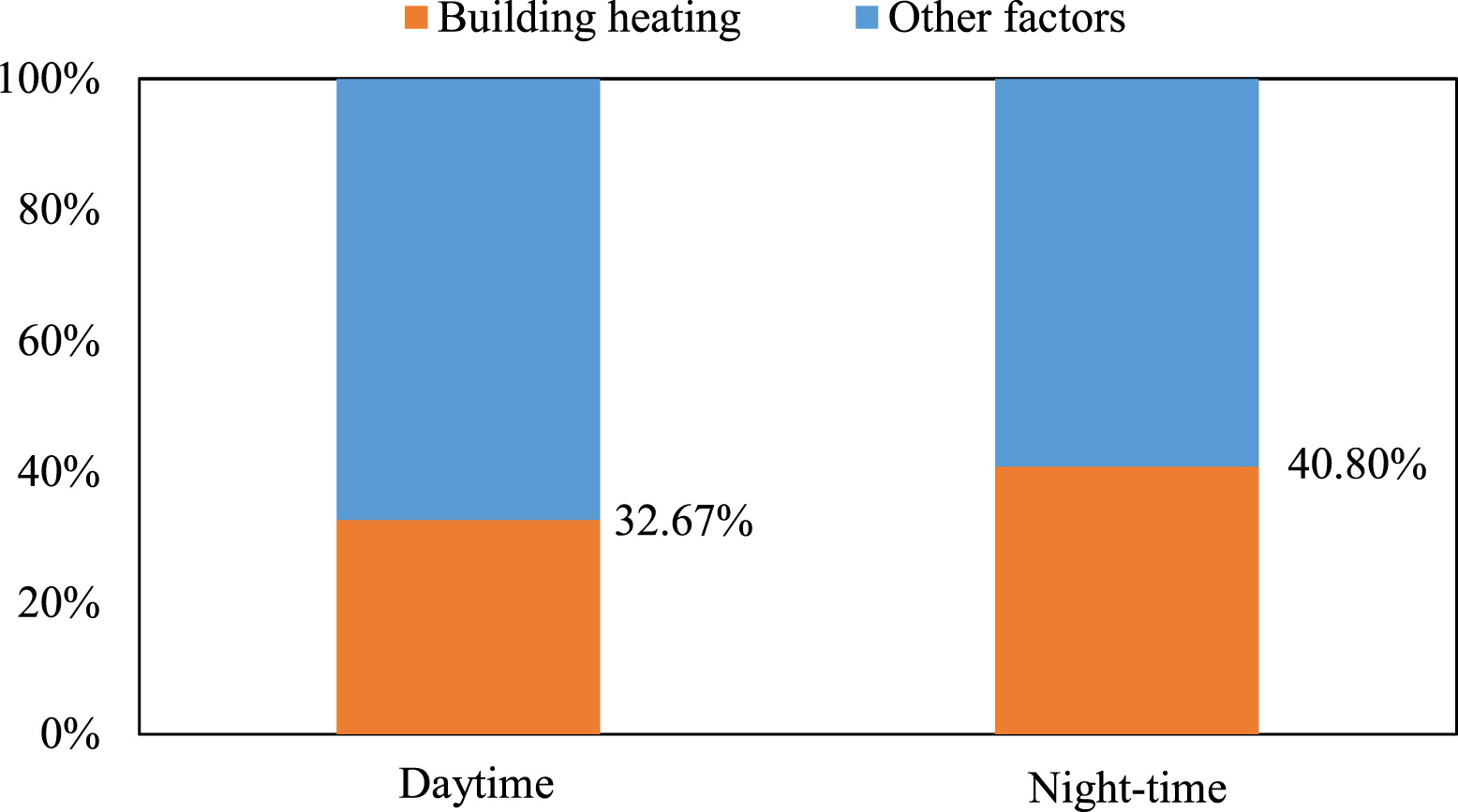 [Contribution from building heating and other factors to the heat-island intensification during the cold wave. From AMS]
Both Chicago and New York City are pursuing ambitious climate action plans, which include the promotion of cool roofs and green roofs to reduce the urban heat island effect. Yang said it remains important to combat summer heat, but cities should not ignore the risks of extreme cold when planning mitigation efforts.
As a potential solution, Bou-Zeid’s group is collaborating with materials expert Anna Laura Pisello and her lab at the University of Perugia in Italy on studies of new color-changing building materials that could ease summer heat while keeping cities warmer in the winter. Yang is also applying the models developed in this study to explore the most effective spatial arrangements for heat island mitigation strategies within a city.
Edited for WeatherNation by Meteorologist Mace Michaels
[Contribution from building heating and other factors to the heat-island intensification during the cold wave. From AMS]
Both Chicago and New York City are pursuing ambitious climate action plans, which include the promotion of cool roofs and green roofs to reduce the urban heat island effect. Yang said it remains important to combat summer heat, but cities should not ignore the risks of extreme cold when planning mitigation efforts.
As a potential solution, Bou-Zeid’s group is collaborating with materials expert Anna Laura Pisello and her lab at the University of Perugia in Italy on studies of new color-changing building materials that could ease summer heat while keeping cities warmer in the winter. Yang is also applying the models developed in this study to explore the most effective spatial arrangements for heat island mitigation strategies within a city.
Edited for WeatherNation by Meteorologist Mace Michaels
[The locations of the 12 studied U.S. cities (courtesy of Google Earth), and their observed UHIs during the early 2014 North American cold wave: (b) daytime and (c) nighttime. From AMS]
Urban heat islands have been extensively studied during heat waves, with recent analyses showing city temperature boosts can be as high as 8 degrees Fahrenheit for large cities like New York City or Washington. Yang and Bou-Zeid’s study is among the first to examine the phenomenon during cold waves. Yang said that for some areas, cold extremes will continue to pose a challenge even as the climate warms. “More weather-related mortality worldwide is attributed to exposure to excessive cold than to excessive heat, and global warming is unlikely to change this reality,” he said.
The researchers combined temperature and land use data with high-resolution weather simulations to investigate the 2014 cold wave in Chicago. The results suggested that heat released from buildings was a key contributor to the stronger heat island effect observed during the cold wave.
“When you heat buildings, the heat is going to be released from the buildings and go out into the urban environment,” Yang said. In the city, skyscrapers create street canyons that trap heat, while in rural areas heat from buildings dissipates more rapidly into the surroundings. During cold waves, street canyons help cities reduce heating demand and make being outdoors more tolerable, Yang said.
[Model-simulated mean (a) daytime and (b) nighttime urban heat island intensity across the study period with different amounts of heat. From AMS]
During the cold wave, Yang and Bou-Zeid also found an enhanced difference in the amount of heat released at night in the city compared to rural areas. Their simulations showed this was due to the city’s thermal battery function — concrete and other engineered materials’ ability to store more heat than soils, and to discharge this heat when temperatures drop. Colder nighttime temperatures appeared to stimulate heat exchange.
Many cities are working on ways to mitigate summer heat. These include installing cool roofs, which are covered with light-reflecting materials; and green roofs, which are covered with plants that reduce temperatures by evaporative cooling when moisture is released into the air. The researchers modified their simulation to test the effects of cool roofs and green roofs on the urban heat island during a cold wave. They found that cool roofs reduced daytime temperatures, while green roofs led to a small increase in daytime temperatures and a somewhat larger reduction in nighttime temperatures, due to the lower heat storage capacity of soils compared to traditional building materials.
Dan Li, an assistant professor at Boston University, said the work offers lessons for planners. “This work highlights the fact that we need to consider the seasonal variability of urban heat islands and assess the associated hazards and benefits in a comprehensive way,” said Li, who conducted doctoral and post-doctoral research with Bou-Zeid but was not involved in the present study.
[Contribution from building heating and other factors to the heat-island intensification during the cold wave. From AMS]
Both Chicago and New York City are pursuing ambitious climate action plans, which include the promotion of cool roofs and green roofs to reduce the urban heat island effect. Yang said it remains important to combat summer heat, but cities should not ignore the risks of extreme cold when planning mitigation efforts.
As a potential solution, Bou-Zeid’s group is collaborating with materials expert Anna Laura Pisello and her lab at the University of Perugia in Italy on studies of new color-changing building materials that could ease summer heat while keeping cities warmer in the winter. Yang is also applying the models developed in this study to explore the most effective spatial arrangements for heat island mitigation strategies within a city.
Edited for WeatherNation by Meteorologist Mace MichaelsAll Weather News
More
Tropical Storm Vance Swirling in the Pacific, Olana Forms East of Hawaii
After becoming a hurricane Friday, Vance has
26 Oct 2026 12:00 AM

Mount Slushmore? Taking a look at Dakota Snow Chances
The cooler weather is finding places to go fi
25 Oct 2026 10:45 PM

Major River Flooding Causes Damage; Another Day of Storms in New Mexico
A powerful low pressure system has been movin
25 Oct 2026 10:25 PM

Sunny Day Flooding; King Tides Surge This Week
This week, the ocean is coming to low lying a
25 Oct 2026 8:55 PM

Warmer Than Average: Above-Normal Temperatures Across the Central U.S. This Week
WHAT TO EXPECTA ridge of high pressure linger
25 Oct 2026 10:15 AM


Several Fires Break Out in SoCal Last Week Amid Santa Ana Wind Event
Santa Ana winds helped several fires grow qui
19 Oct 2026 1:25 PM