NASA's ARIA Team Maps California Quake Damage
Special Stories
18 Jul 2019 1:28 AM
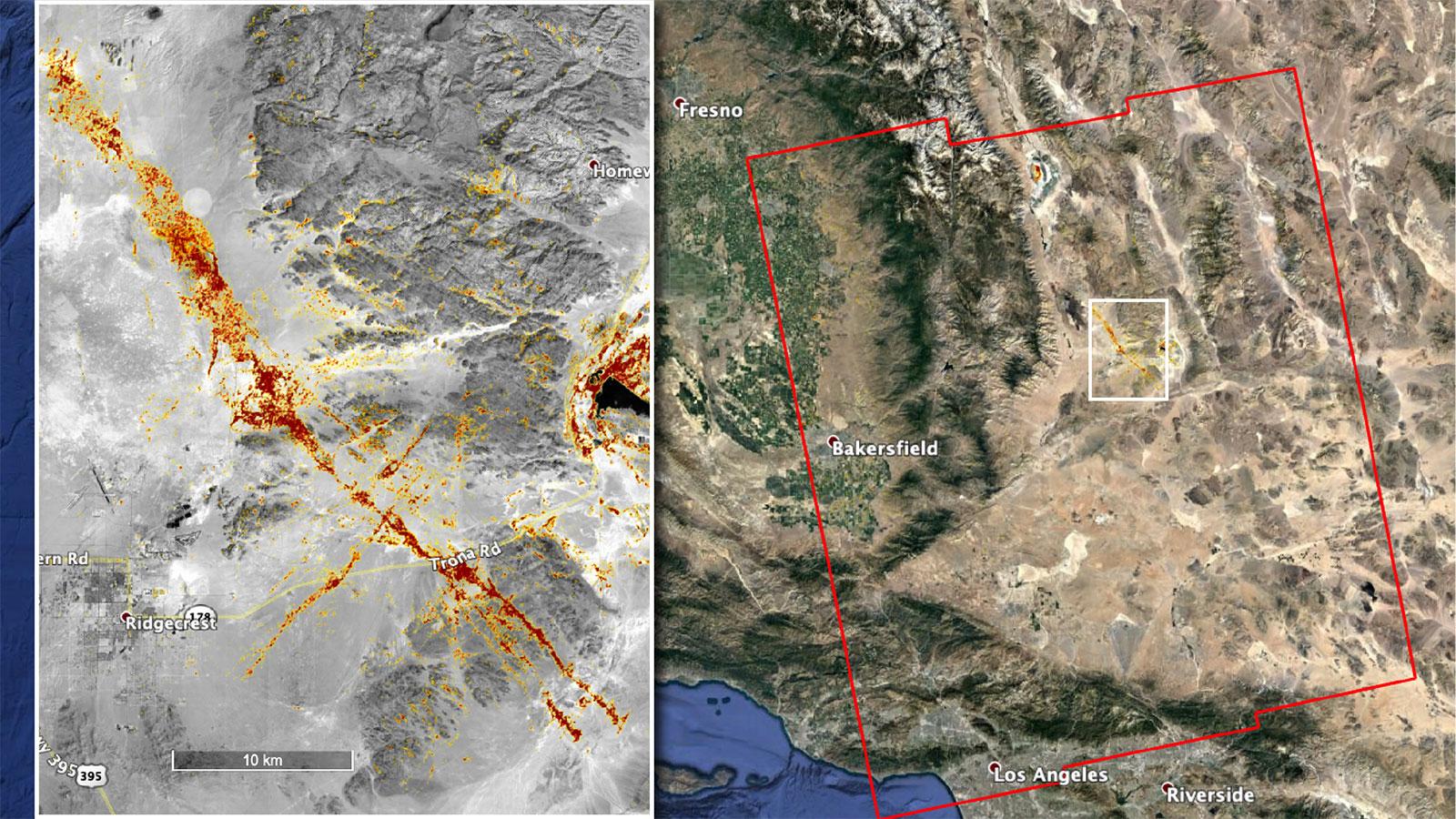
[NASA's ARIA team produced this map of earthquake damage in Southern California from the recent temblors. The color variation from yellow to red indicates increasingly more significant surface change, or damage. Credits: NASA/JPL-Caltech, ESA]
[NASA] After the recent strong earthquakes that struck near the city of Ridgecrest in Southern California, NASA scientists and engineers continue to analyze satellite data for information on fault slips and ruptures. Their observations are helping local authorities assess damage and will also provide useful information to engineers for designing resilient structures that can withstand ruptures like the ones created by the latest quakes.
https://www.facebook.com/WeatherNation/videos/790970887966847/
The Advanced Rapid Imaging and Analysis (ARIA) team at NASA's Jet Propulsion Laboratory in Pasadena, California, created this map depicting areas that are likely damaged as a result of the recent major earthquakes. The color variation from yellow to red indicates increasingly more significant surface change, or damage. The map covers an area of 155 by 186 miles (250 by 300 kilometers), shown by the large red polygon. Each pixel measures about 33 yards (30 meters) across.
https://www.facebook.com/WeatherNation/videos/2095341780575577/
To make the map, the team used synthetic aperture radar (SAR) images from the European Space Agency's Copernicus Sentinel-1 satellites from before and after the sequence of quakes — July 4 and July 10, 2019, respectively. The map may be less reliable over vegetated areas but can provide useful guidance in identifying damaged areas.
https://twitter.com/gretchengillis/status/1146852519659761664
NASA's Disasters Program is in communication with the California Earthquake Clearinghouse, which is coordinating response efforts with the California Air National Guard, the U.S. Geological Service and the Federal Emergency Management Agency. NASA analysts are using data from satellites to produce visualizations of land deformation and potential landslides, among other earthquake impacts, and are making them available to response agencies. NASA's Disasters Program promotes the use of satellite observations in predicting, preparing for, responding to and recovering from disasters around the world.
Edited for WeatherNation by Meteorologist Mace Michaels
All Weather News
More
Sub-Tropical Josephine Becomes Tenth Atlantic Named Storm
SETUPAn upper-level low broke off from the fl
22 Oct 2026 1:40 AM

Warmer Than Average: Above-Normal Temperatures Across the Central U.S. This Week
WHAT TO EXPECTA ridge of high pressure will b
22 Oct 2026 1:40 AM

Severe Weather & Heavy Rainfall Aims for the West This Week
Looking ahead to this week, a low-pressure sy
22 Oct 2026 1:35 AM

Tropical Storm Vance Forms In The Pacific
Isaias ended the late-season streak of no hur
22 Oct 2026 1:20 AM

Several Fires Break Out in SoCal Last Week Amid Santa Ana Wind Event
Santa Ana winds helped several fires grow qui
19 Oct 2026 1:25 PM

Another Cold Morning Before Things Warm Back Up
Across portions of the Ohio Valley through th
19 Oct 2026 10:15 AM

Severe Risk Diminishing Saturday Morning for the Northeast
Severe Storm PotentialSevere risk is decreasi
16 Oct 2026 10:20 AM