NOAA Announces Upgrade to Super Computers
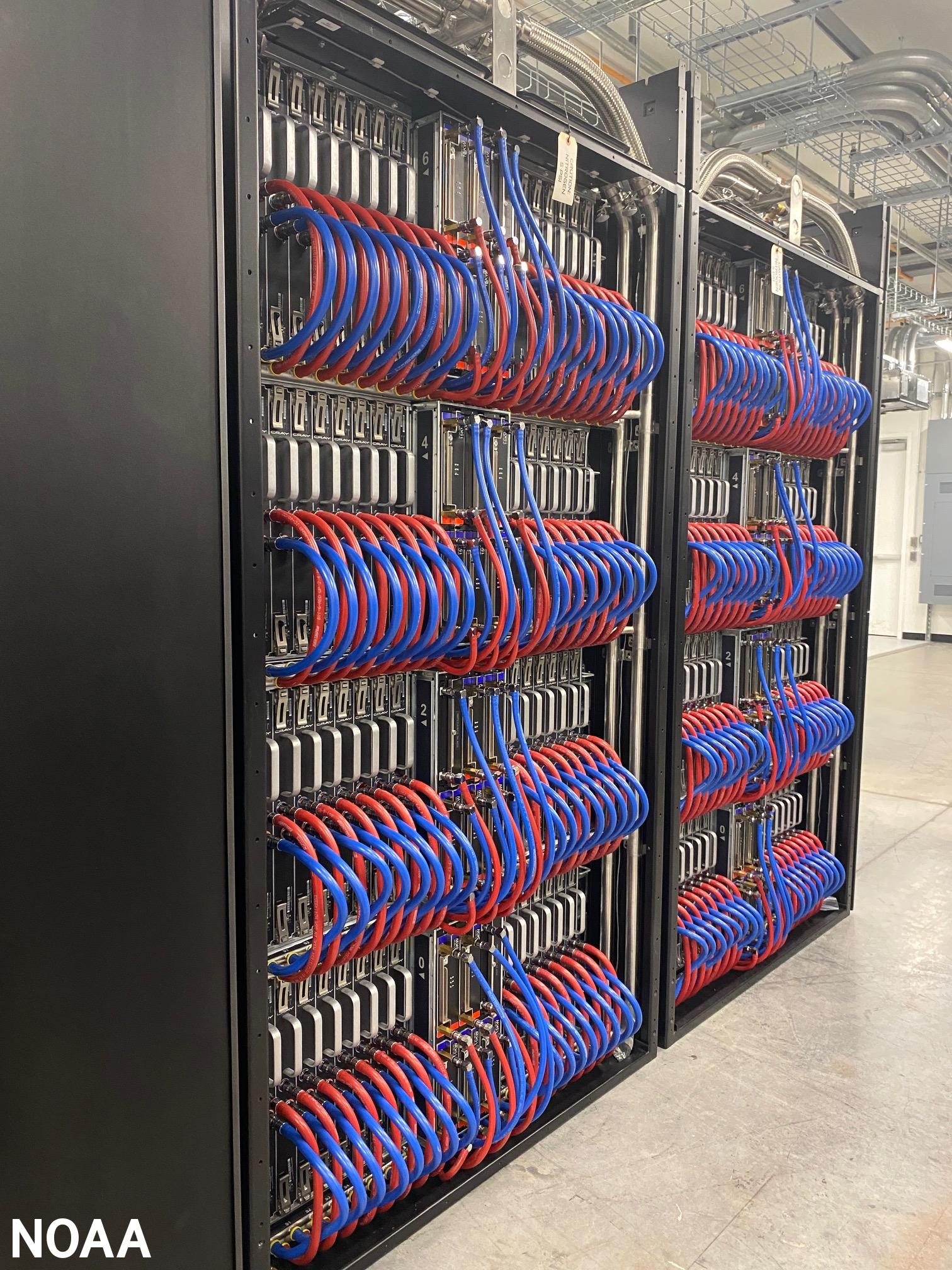
NOAA’s supercomputer Dogwood, located in Manassas, Virginia (2023). (Image credit: NOAA)
We had the opportunity to sit down with the Director of the National Weather Service, Ken Graham to discuss the supercomputer capabilities and how it will improve forecast accuracy and decision making for the nation.
The National Oceanic and Atmospheric Administration (NOAA) announced the expansion of the weather "supercomputer" this week - increasing the capacity by 20%. According to NOAA, "the increased computing power and storage will help improve forecast model guidance for years to come and allow for other weather prediction advances."
The Weather and Climate Operational Super Computing System (WCOSS) is actually two systems, the Dogwood and Cactus, located in Manassas, VA and Phoenix, AZ, respectively. The two computers are contracted with General Dynamics Information Technology (GDIT) as part of a acquisition, upgrade, products and services contract spanning 8 years with a 2 year option renewal.
NOAA scientists expect the increase in computing power to help with more complex forecast models; the upgrade allows for 29 quadrillion calculations ... per second. This allows more data to be imputed into the computers and more data to be stored.
It is part of a plan to upgrade the U.S. "GFS" or Global Forecast System Model and make the model hirer resolution. Currently, it has a 13km resolution, the goal is to get it to 9km. Additional advancements are expected with the "radiatively active aerosols" product to better predict wildfire smoke, dust and fog.
The HRRR, or Rapid Refresh Model will also get a boost, with more forecast potentials and data included in each run of the model.
Over 20 models run on the WCOSS. There are additional supercomputers in West Virginia, Tennessee, Mississippi and Colorado that add to NOAA's fleet. According to the National Weather Service Director, Ken Graham, “This increased supercomputing power allows for upgrades to specific modeling systems that will help weather forecasters deliver more accurate weather forecasts, watches and warnings and improved certainty in a forecast.”
The latest upgrade to the WCOSS comes as NOAA advances the Hurricane Analysis and Forecast System model with the NHC. Now operational, the model aims to better predict rapid intensification and storm surge during hurricanes.
You can read the full press release here.


